A Guide to Mercury Outboards: Engine Types and Applications
Two boats can carry the same number of people, run the same horsepower and still need very different engine setups.
The reason is everything around the engine. Boat length and hull design affect the power needed, while the transom, engine weight and shaft length determine how that power fits the boat. Intended use matters too. A recreational fishing boat has different demands from an offshore fishing boat, and a boat working long hours needs an engine designed for that kind of use.
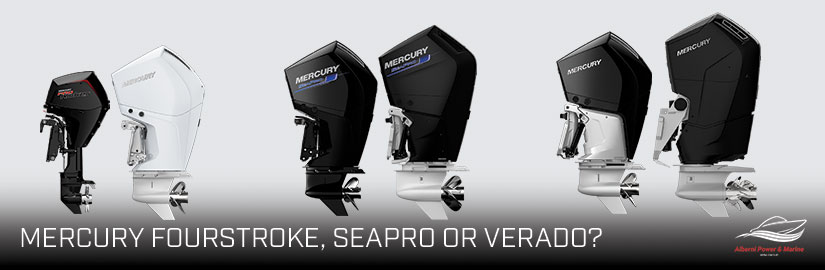
Mercury Marine's FourStroke, Verado and SeaPro families cover these different applications. Understanding where each fits makes it easier to narrow down the right engine before getting into horsepower, rigging and repower considerations.
Let’s review some key criteria for selecting the right engine.
Understand the Boat’s Specifications & Recommended Power
Your vessel’s specifications give a starting point.
First, check the manufacturer's maximum horsepower rating. From there, consider your boat's length, hull design, weight, passenger and gear load, and how you will use the vessel. Aluminum boats used for freshwater fishing have different requirements than larger fiberglass boats carrying several passengers offshore.
The water condition itself also matters. A boat used on inland lakes has different demands from one regularly operated in coastal saltwater. For boaters running offshore fishing boats, the engine needs to handle heavier loads and longer runs while still providing the power and control expected from the hull.
There is no single horsepower figure that applies to every boat of a particular length. As a broad reference, the supplied guide places smaller boats up to around 16 feet in the 15–100 HP range, while boats around 17–25 feet may use roughly 75–300 HP. Larger boats can require considerably more power.
3 Top Mercury Outboard Lineups Preferred by Canadian Boaters
1. Mercury FourStroke: Get Versatile Power for Recreational Boating
This outboard engine family from Mercury Marine covers one of the broadest ranges of recreational applications.
Owners of fishing boats, offshore boats, and other aluminum & fiberglass boats prefer these boat motors due to their performance & reliability. The range extends from small 2.5 HP tiller-steered models to 300 HP V8 engines, with configurations that vary by application.
For Canadian boaters, that versatility offers power for a wide range of recreational activities, from everyday boating to fishing and cruising. Mercury FourStroke models also suit the needs of commercial operators, giving owners options for different workloads and working conditions.
Some FourStroke models by Mercury also offer features suited to particular boats and operating conditions. For instance, Command Thrust gearcases enable you to handle heavier loads, while specialty configurations support applications such as shallow-water boating.
2. Mercury SeaPro: Designed for Commercial Applications
A recreational boat might spend a few hours on the water during a weekend. But a commercial vessel runs for hours every day.
Mercury SeaPro engines are designed for those higher-hour applications. The range covers 15–500 HP and is intended for commercial uses including fishing, ecotourism, water taxis, whale watching, shipping and construction. Mercury uses different calibration and operating characteristics for SeaPro to address the demands of commercial service. Operators prefer these outboard motors for sale and experience improved throttle response & drivability, adaptive speed control, higher torque even at lower RPM, and best-in-class fuel efficiency.
That makes SeaPro a different choice than simply picking a recreational engine with enough horsepower. For instance, the heavy-duty gearcases and 150-amp alternator on the 350 HP model provide specific examples of its work-oriented design. For owners who depend on their boat as part of their business, engine durability, service access and long-term operating demands become central to the selection.
Mercury states that it validates SeaPro engines to three times the life of recreational engines. That is a manufacturer claim, but it illustrates the intended difference between the SeaPro platform and a recreational outboard.
3. Mercury Verado: More Power for Larger Applications
Verado occupies the higher-horsepower end of Mercury's recreational lineup.The premium range includes V8 (250 & 300 HP), V10 (350 HP, 400 HP, & 425 HP), and V12 models, with the V12 Verado reaching 600 HP. Verado is intended for applications that combine high horsepower with smooth, quiet operation, advanced controls, and strong torque. It is particularly suited to larger center consoles, deep-V fishing boats, offshore fishing boats, luxury cruisers and larger pontoons.
Digital Throttle & Shift is available across the Verado range, while Mercury's supporting technology can add features such as SmartCraft monitoring and Joystick Piloting on compatible multi-engine installations. With superior refinements like engine noise cancellation, minimal vibration, impressive responsive power with sensational top speed & effortless handling, Mercury Verado delivers a premium driving experience.
For a boat that spends long days travelling to fishing grounds or carrying a substantial passenger and gear load, the combination of horsepower, torque and control becomes particularly relevant. This is where the Verado range starts to make sense as part of the overall boat package. For example, the V12's two-speed transmission and independently steerable gearcase set it apart from other families.
3 Factors to Consider While Buying an Outboard (Apart from Horsepower)
Once you narrow your choice to a specific engine family, keep the factors below in mind when selecting the model.
-
Engine Weight
It affects how the boat sits and handles. A heavier engine adds more weight to the transom, so the hull and transom need to be suited to it. -
Shaft Length
Matching the transom is essential. Common shaft lengths include 15, 20, 25 and 30 inches. The anti-ventilation plate should sit correctly in relation to the hull for the engine to operate properly. -
Engine Configuration
Another important point when choosing an engine for larger boats is configuration. Depending on the hull and its rated capacity, you can set up a boat with a single, twin, triple or even larger multi-engine configuration.
Working with an experienced boat dealer is valuable in making a well-informed decision. Their team will help you select the engine that suits the hull, control, rigging, and the way you will actually operate the boat, not just what is physically appropriate on the transom.
Mercury Outboard Comparison: FourStroke vs. Verado vs. SeaPro
Mercury’s FourStroke, Verado and SeaPro outboards are designed for different boating needs. This quick comparison highlights their horsepower ranges, intended applications and key features to help narrow down which engine family may suit your boat.
Engine Family |
FourStroke |
Verado |
SeaPro |
| Horsepower Range | 2.5 – 300 HP | 250 – 600 HP | 15 – 500 HP |
| Cylinder Configuration | Inline L1-L6, V6-V8 Cylinder | V8-V12 Cylinder | L2-V12 Cylinder |
| Best Suited For | Recreational fishing, family boating, pontoons and general use | Larger recreational & commercial boats, offshore fishing and heavy boat packages | Commercial fishing, workboats and boats with demanding operating schedules |
| Smoothness and Noise Control | Smooth four-stroke operation | Advanced MidSection (AMS) helps isolate engine vibration; noise-reduction technology helps create a quieter ride. | Some models feature AMS; V8 and V6 models use tuned intake and exhaust systems to reduce operating noise. |
| Controls and Handling | Available with mechanical or digital controls, depending on model | Digital Throttle & Shift (DTS) is integrated across the Verado range. Electro-hydraulic power steering is also available, with option to add Joystic piloting. | DTS on select models; Adaptive Speed Control helps maintain RPM as load or conditions change |
| Work-focused Features | Features vary by model and application | Easy-access oil-check door, color-coded service points and corrosion protection | Heavy-duty gearcases, high-output alternators, easy-access maintenance points and corrosion-resistant components |
Specifications and features vary by model. Confirm the details of the specific engine with your dealer before you choose.
While Repowering Your Boat
Repowering makes sense when the existing hull remains in good condition. But replacing an engine involves more than removing the old motor and installing a new one. You also need to consider the transom's condition, the age of the rigging, control compatibility, and digital network integration.
A properly planned repower with an experienced, knowledgeable team at a Mercury Repowering Centre can also bring newer technology, improved reliability and updated controls to an existing boat. Mercury's SmartCraft system provides real-time engine performance and diagnostic information on compatible applications, while DTS and other technologies can be integrated into the overall setup.
For Canadian boat owners, it can be especially relevant when an otherwise well-maintained fishing boat still has many seasons of use left in the hull.
Keep Check on the Maintenance Schedule
The engine selection is only the beginning of ownership.
Regular servicing helps keep your Mercury outboard in good condition. Check the oil, fuel and cooling systems, and keep the motor and propeller clean. After using the boat in saltwater, flush the engine with fresh water. If you're putting the boat away for winter, don't forget to have it winterized.
You can also book professional marine services for routine maintenance and seasonal servicing. They will help you keep up with the recommended service schedule to protect the engine's performance and extend its working life.
How often your engine needs servicing depends on its model, how frequently you use it and the conditions it operates in. During a repower, it's also worth having a professional check the rigging, controls and digital systems to make sure everything is installed and working properly.
Conclusion
Choosing a Mercury outboard comes down to your boat, how you use it and the kind of performance you need. FourStroke models cover a wide range of recreational boating, Verado offers high horsepower for larger boats, and SeaPro is built for boats that spend long hours working on the water. The right engine is one that suits your boat and the way you use it.
For boat owners comparing Mercury outboards BC, planning a new boat, or considering a repower, an experienced Mercury dealer can match the engine, rigging, and controls to the boat rather than treating horsepower as the only consideration.
Alberni Power & Marine, with the largest inventory of Mercury outboards in Canada, supports you through sales, installation, repower work and ongoing marine services. Their team helps boat owners find an engine setup that fits the boat and how it is used.
Frequently Asked Questions
Q.1. What horsepower Mercury outboard do I need?
Start with the maximum horsepower recommended by your boat's manufacturer. From there, consider how you use the boat, how much weight it carries and the type of hull. A boat used for offshore fishing with several passengers and gear may have different power requirements from one used for casual cruising. The engine's weight and shaft length also need to suit the boat. A Mercury dealer can help you check these details and find an engine that fits your setup.
Q.2. Which Mercury outboard is suited to general recreational boating?
Mercury FourStroke is the most versatile of the main recreational engine families. With models ranging from 2.5 HP to 300 HP, it covers applications such as fishing boats, pontoons, cruisers and other recreational vessels. Depending on the model, buyers can choose different steering and control options, including tiller and remote steering. Some models also offer Command Thrust gearcases for boats carrying heavier loads. The right model depends on the boat's specifications and intended use.
Q.3. Which Mercury outboard is the most reliable?
Reliability depends on the quality of engine’s components and how long it runs without requiring repairs. Engine stress plays a major role, as boat motors that produce more torque at lower RPM can experience less strain during operating hours. Mercury’s high-horsepower range includes large displacement engines like 3.4L V6, 4.6L V8, 5.7L V10, and 7.6L V12. Such displacement helps the engine deliver strong torque, reduce powerhead stress, and support long-term durability. For example, the SeaPro 200-300 HP lineup suits ideally to the commercial applications, with focus on sustained operation and lower-RPM torque. Its heavy-duty gearcase are built for demanding workloads, with Mercury validating certain SeaPro gearcases at three times the lifespan of recreational gearcases. These design features and characteristics make SeaPro highly reliable for commercial use.
Q.4. When does a Mercury Verado make sense?
Mercury Verado is a premium outboard range designed for higher-horsepower applications. Its V8, V10 and V12 models deliver power alongside smooth, quiet operation and advanced control systems. The range suits larger recreational boats, offshore fishing boats, and other vessels that require substantial power. Features such as Digital Throttle & Shift, Joystick Piloting, and Advanced MidSection technology help improve control and reduce vibration. The V12 Verado is available with up to 600 HP per engine.
Q.5. What is a Mercury SeaPro outboard designed for?
Mercury SeaPro outboards are built for boats that spend long hours on the water, including commercial fishing boats, workboats and passenger vessels. With horsepower options from 15 to 500 HP, the range covers a variety of working applications. Compared with recreational outboards, SeaPro models have heavy-duty components and gearcases designed to handle frequent use. They also include features that make routine servicing easier and help protect against corrosion, particularly in saltwater environments.
Q.6. What does ELPT mean on a Mercury outboard?
ELPT is a Mercury model designation commonly used to describe an engine's configuration. E stands for electric start, L for long shaft and PT for power trim and tilt. For example, a Mercury 15 ELPT has electric starting, a 20-inch shaft and power trim. Models, especially in smaller categories like 15 and 20 HP, are available in various configurations. Hence, the model name help identify the engine's features, but buyers should still confirm the exact model and shaft length against their boat's transom before purchasing.
Q.7. Is repowering a good option instead of buying a new boat?
Repowering can be a suitable option when the existing hull is in good condition and still meets your boating needs. Replacing the engine can bring updated technology, controls and performance without the expense of purchasing another boat. However, the assessment should include the transom's condition, existing rigging, steering, controls and compatibility with the new engine. A Mercury dealer can inspect the current setup and provide a quote for the engine, installation and any required upgrades.
Q.8. What does it cost to replace a marine engine?
The cost of replacing a marine engine depends on its horsepower, model, boat configuration and the work required for installation. A small outboard replacement is generally a different project from repowering a large offshore boat with a high-horsepower engine. The total quote may include the engine, controls, steering, gauges, propeller, wiring, removal of the old motor and labour. Transom repairs or additional upgrades can increase the cost. A dealer inspection is the best way to obtain an accurate estimate.
Q.9. What is the average lifespan of a Mercury FourStroke engine?
There is no fixed lifespan for a Mercury FourStroke engine. Engine hours, average RPM, and average time spent at high RPM are some crucial factors that affect wear. Mercury Marine recommends avoiding prolonged operation at maximum RPM and keeping the engine within its specified full-throttle range. Also, higher displacement can provide more torque at lower RPM, which potentially reduces engine workload when the motor is correctly matched to the boat. Review maintenance records and have a qualified technician inspect a used engine when assessing its condition.
Q.10. Where can I buy Mercury outboards in Canada?
Mercury outboards are available through authorized Mercury dealers across Canada. A dealer can help you compare FourStroke, Verado and SeaPro models, confirm engine compatibility and arrange the required controls and rigging. Buyers can also discuss installation, warranty coverage and ongoing maintenance before purchasing. Alberni Power & Marine in Port Alberni, BC, offers Mercury outboard sales, repowering, and marine services, backed by their top-rated Mercury Service Center in Western Canada, longstanding Mercury CSI Award recognition, and thelargest outboard inventory in Canada. When comparing prices, ask whether the quote includes installation and the equipment your boat needs.
About the Author
Stephan Zilliken
Stephan Zilliken, founder of Alberni Power & Marine and Rods Power Marine, has spent more than half his life shaping the marine industry. What began with a passion for fixing and fine-tuning boats grew into leading one of the country’s most trusted Mercury Marine dealerships. His long partnership with Mercury Marine since the mid-1990s helped establish Alberni Power & Marine as a synonym for quality and performance on Canada’s West Coast. Known for his meticulous attention to detail in powering, repowering, and service, Stephan built his reputation one boat at a time. While he no longer works as a boat mechanic, his expertise and guidance still inspire the team, suppliers, and customers who value his deep knowledge of boating and marine technology.